 HD Trailers Team
Why Trailer Prices Vary So Much (And What You’re Really Paying For)
 HD Trailers Team : May 11, 2026
Compare heavy haul trailer pricing, from steel and deck height to axles, warranties, payload, and long-term cost.

Two trailers can look nearly identical from twenty feet away, with the same general shape, similar rating, and similar purpose. But not every steel-built trailer is constructed the same way. Some use T1 steel in critical structural areas, while others rely more heavily on standard structural steel. For buyers, the key question is how the trailer is built to handle the loads, routes, and work it is meant to perform.
A heavy-duty trailer must carry concentrated weight, flex under load, absorb road vibration, and handle repeated hauling cycles. Over time, it must do more than support a single load. It must remain reliable across many jobs.
Material choice plays a role in how that performance is achieved. Some trailers use higher-strength steel in key areas, while others rely on additional material or simpler construction to meet strength requirements. Understanding those tradeoffs is more useful than focusing on price alone.
A better question to ask is not just, “How much does this trailer cost?” but “What was this trailer built to handle?”
T1 steel is commonly used in heavy-duty trailer applications where strength and weight efficiency matter. When used in the right structural areas, it can help a trailer handle demanding work without adding unnecessary weight.
Trailer weight directly affects payload capacity and hauling flexibility. A well-designed trailer places strength where it is needed rather than increasing weight across the entire structure.
Buyers may also see features such as high-yield flanges, fabricated I-beams, or closely spaced crossmembers. These details are not always visible at a glance, but they influence how a trailer performs under repeated heavy loads.
Buyers may also see premium trailers described with high-yield flanges, fabricated I-beams, or closely spaced crossmembers. Those details may not be obvious from twenty feet away, but they can affect how the trailer carries repeated heavy loads over time.
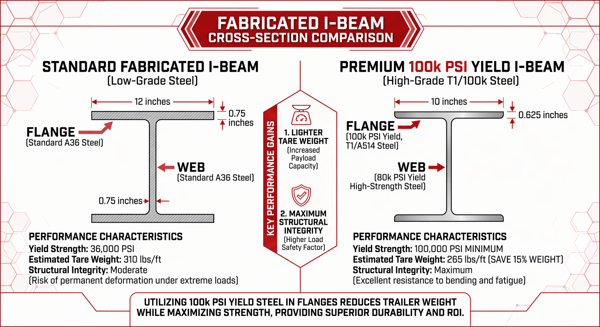
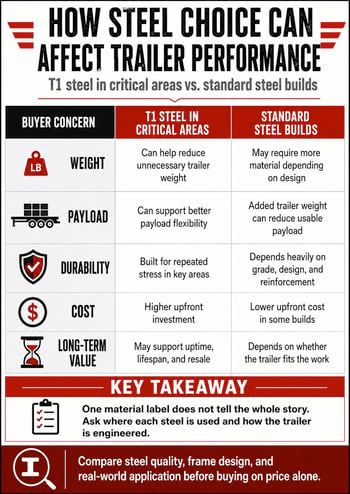
Standard steel can be appropriate for many applications, depending on grade and design. In some cases, more material may be required to achieve the same strength, which can increase overall trailer weight and reduce payload capacity.
This does not make standard steel a drawback. It simply means the trailer should match the intended workload and operating conditions.
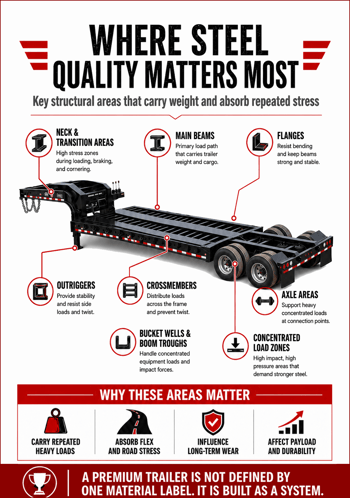 Steel quality matters most in the parts of the trailer that carry weight and absorb repeated stress, including:
Main beams
Flanges
Crossmembers
Neck and transition areas
Axle areas
Outriggers
Bucket wells and boom troughs
Other concentrated load zones
These components work together as a system. Overall performance depends on how the frame is designed, reinforced, and integrated, not on a single material specification.
The purchase price is only one part of the equation. Steel choice and design influence payload, uptime, lifespan, and resale value.
A heavier trailer may limit hauling flexibility, while an underbuilt trailer may require more maintenance over time. A trailer that does not align with the work it is expected to perform can also lose value more quickly at resale.
Before choosing between trailers, buyers should ask:
What type of steel is used?
Where is T1 steel used?
Where is standard steel used?
What is the yield strength?
What material is used in the beams, flanges, web, and crossmembers?
How far apart are the crossmembers?
Where is the frame reinforced?
How is the trailer engineered for concentrated loads?
How does the material choice affect weight, payload, deck height, and rated use?
Are the flanges high-yield, such as 100,000 PSI minimum yield where applicable?
Are the beams fabricated I-beams or a simpler design?
What crossmember spacing is used, and why?
Those answers should be matched to real-world use:
What are the heaviest loads?
What types of loads will be hauled most often?
What routes will the trailer run?
How frequently will the trailer be used?
Will the trailer see consistent heavy-duty use or occasional loads?
Is the goal to handle one specific job, or to stay flexible as the business grows?
Comparing trailers requires looking at steel type, frame design, axle configuration, and overall application, not just price. Each of these factors contributes to how the trailer performs over time and how well it fits the intended work.
HD Trailers can help buyers evaluate these details and make informed decisions. Before you buy based on price alone, contact HD Trailers to make sure the trailer is built for the loads, routes, and work you need it to handle.
 HD Trailers Team : May 11, 2026
Compare heavy haul trailer pricing, from steel and deck height to axles, warranties, payload, and long-term cost.
 HD Trailers Team : Aug 04, 2026
A trailer’s tonnage rating only tells part of the story; the right axle setup can impact legal weight, permits, routes, load flexibility, and the...
%20-%202026-07-01T151549.458.png) HD Trailers Team : Sep 25, 2026
HD Trailers Team : Sep 25, 2026
HD Trailers goes beyond being a dealer to provide tailored heavy haul trailer solutions, financing options, and expert guidance for your business...
 HD Trailers Team : Aug 04, 2026
How to choose the right heavy haul trailer by understanding trailer specifications such as typical loads, loaded deck height, usage, and more.