 HD Trailers Team
How to Choose the Right Trailer for Your Equipment
 HD Trailers Team : May 26, 2026
The right work trailer is not just the one that handles today's load, but the one that keeps your operation eligible for better work tomorrow.
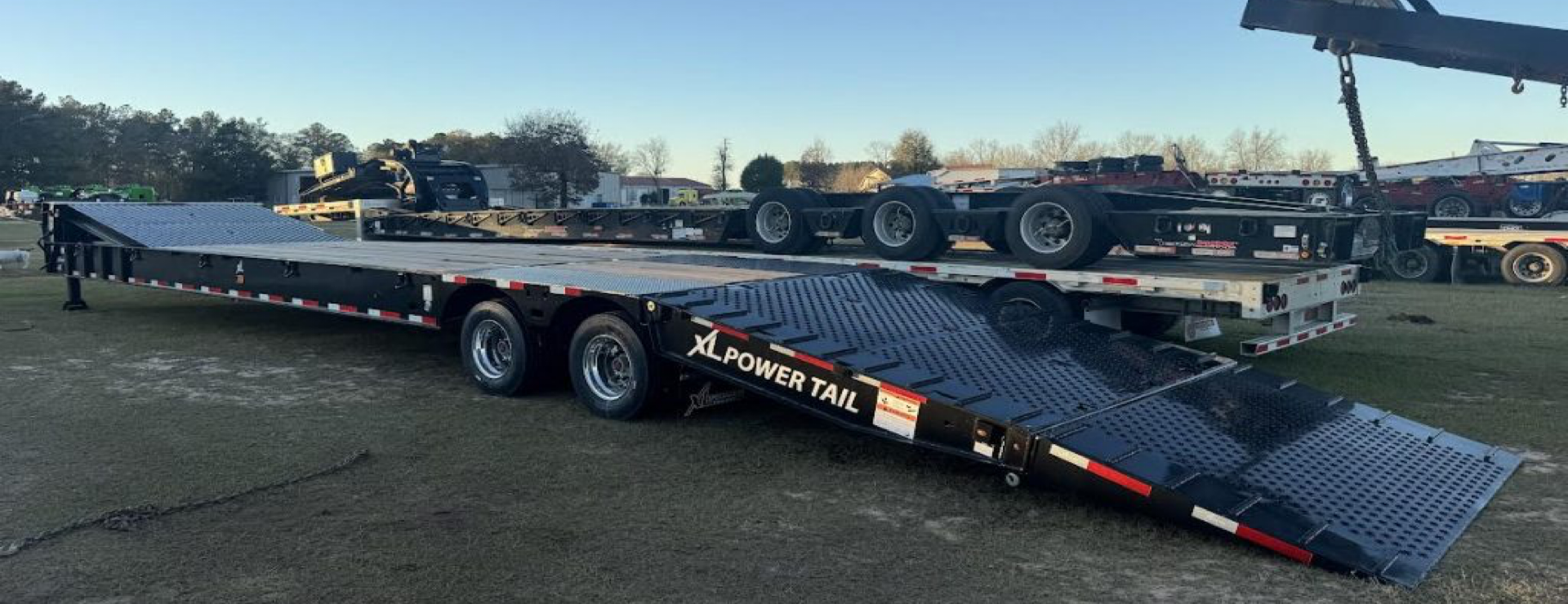
"Why is this trailer $30,000 more than another one that looks almost the same?"
If you have compared quotes across manufacturers or dealers, you have probably asked that question. It's a fair one. When two trailers have similar tonnage ratings and the same overall length, a five-figure price gap does not seem to make sense.
The problem is the assumption behind the question: that the trailers are truly comparable. In heavy haul, what you cannot see from twenty feet away is often exactly what you are paying for.
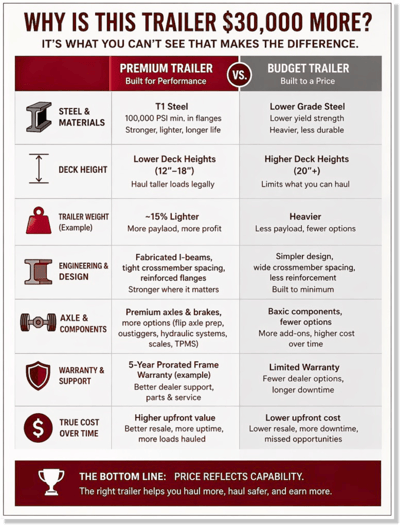 Materials are the starting point. Premium heavy-duty trailers are built with T1 steel, the highest grade commonly used for this application. T1 delivers much higher yield strength, including 100,000 PSI minimum in the flanges, while weighing less per foot than standard A36 steel.
In I-beams, that can reduce weight by about 15% while improving resistance to bending and fatigue. Manufacturers using lower-grade steel can offer a lower upfront price, but the tradeoff shows up in weight, durability, and long-term performance.
Engineering and trailer weight go hand in hand. Getting a deck down to 12 or 18 inches off the ground while still maintaining full load capacity takes more sophisticated design, including fabricated I-beams, tight crossmember spacing, and reinforced flanges. That costs more to build, but it is what makes the trailer both strong and efficient. Budget trailers often end up heavier, not because they are stronger, but because the design is less refined. That extra weight cuts directly into payload capacity.
Deck height is another major pricing factor many buyers underestimate. A lower deck height requires heavier-gauge materials and more precise fabrication. But that extra cost can pay for itself quickly when you can haul loads a taller trailer cannot. Saving even four inches in deck height can mean the difference between a legal load and an illegal one under bridge laws.
Axle configuration and components add another layer of cost and capability. Features like these raise the price, but they also expand what the trailer can do:
Moving from a two-axle to a three-axle setup
Adding flip axle prep
Including outriggers
Adding hydraulic systems
Adding digital scales or tire inflation systems
The question is not whether those features cost more. It's whether the work you want justifies the investment.
Not every manufacturer builds to the same standard. Premium manufacturers like XL Specialized and Kalyn Siebert command higher prices because of their materials, engineering precision, and warranty support.
An XL trailer might cost 10% to 15% more than a comparable Alpha trailer. All three may use T1 steel and high-yield flanges, but differences in finish quality, design, and component options become more noticeable over time.
Then there are direct-to-consumer brands. They cut out the dealer network to lower the price, sometimes by $20,000 to $40,000 on a trailer that looks similar at first glance. But similar-looking and similarly capable are not the same thing.
That $30,000 gap between two trailers with the same tonnage rating is rarely caused by one major difference. More often, it comes from a series of smaller differences that add up:
Heavier trailer weight that reduces payload
Higher deck height that limits legal loads
Lower-grade steel that shortens lifespan
Key components treated as add-ons instead of standard equipment
From the outside, the trailers may look nearly identical. On the spec sheet, the differences become clearer. On the job, they show up fast.
The real cost of buying cheap is not the purchase price. It is what happens afterward. Buyers who save $20,000 upfront often end up wanting to trade out of that trailer within a year or two. Then they are stuck with lower resale value and, in some cases, a dealer who will not even take it in on trade because they do not carry that brand.
Downtime adds even more cost. Every day a trailer sits idle because of poor dealer support or parts delays is a day you are not earning. Saving $5,000 on a budget brand can disappear with a single lost week of work. And every week you are running the wrong trailer is another week of loads you could not take.
Premium trailers can also offer better protection after the sale. Kalyn Siebert, for example, provides a five-year prorated frame warranty that covers 100% in the first year.
Price reflects capability, not just cost. You are not just paying for steel and paint. You are paying for capacity, durability, access to work, and the ability to say yes when the phone rings. The cheapest option on the lot is almost never the cheapest option over the life of your business.
For a deeper look at how specs, manufacturers, and configuration decisions all connect, our full buyer's guide, Before You Spend $100K+ on a Trailer - a practical buyer's guide for anyone in heavy-duty and equipment hauling, walks you through the complete picture.
 HD Trailers Team : May 26, 2026
The right work trailer is not just the one that handles today's load, but the one that keeps your operation eligible for better work tomorrow.
%20-%202026-08-24T125429.867.png) HD Trailers Team : Jun 23, 2026
HD Trailers Team : Jun 23, 2026
Avoid costly mistakes when buying your first trailer. Learn key insights on pricing, critical components, and making informed decisions for your...
![[New Guide] Your Trailer Isn't Equipment. It's Your Business Plan on Wheels.](https://blog.hdtrailers.com/hubfs/5%20trailer%20buying%20mistakes-1.png) HD Trailers Team : Jun 09, 2026
HD Trailers Team : Jun 09, 2026
[NEW GUIDE] Spec the right heavy-duty trailer before you buy - avoid costly mistakes, win more jobs, and invest with confidence.
%20-%202026-07-07T121427.973.png) HD Trailers Team : Sep 28, 2026
HD Trailers Team : Sep 28, 2026
Choosing the right heavy-duty car hauler for your business involves understanding your unique needs, from vehicle types to loading efficiency.