 HD Trailers Team
Costly Trailer Buying Mistakes Most First-Time Buyers Make
 HD Trailers Team : Jun 23, 2026
Avoid costly mistakes when buying your first trailer. Learn key insights on pricing, critical components, and making informed decisions for your...

Most buyers who call us looking for a trailer already know what they're hauling. They can tell you the equipment, the weight, sometimes even the brand and model. What they often don't know is which trailer configuration actually fits that work - not just today, but six months or a year from now.
That gap between knowing your equipment and knowing your trailer is where the most expensive mistakes happen. Not because buyers aren't paying attention, but because this isn't a decision you make every day. And the wrong choice doesn't just sit in your yard - it actively limits what jobs you can take.
The first thing any good dealer is going to ask isn't about budget or brand preference. It's about your operation. Are you hauling yellow iron - excavators, bulldozers, the heavy construction equipment? Moving municipal equipment like fire trucks or buses? Getting into specialized work like data center components or oversized loads?
From there, how much does the equipment weigh? That determines your axle configuration - two axles handle a very different load range than three. And how often are you hauling? A buyer running loads five days a week has very different durability needs than someone moving equipment once or twice a month. Frequency changes everything from the build quality you should invest in to how fast wear items like decking, brakes, and suspension will need attention.
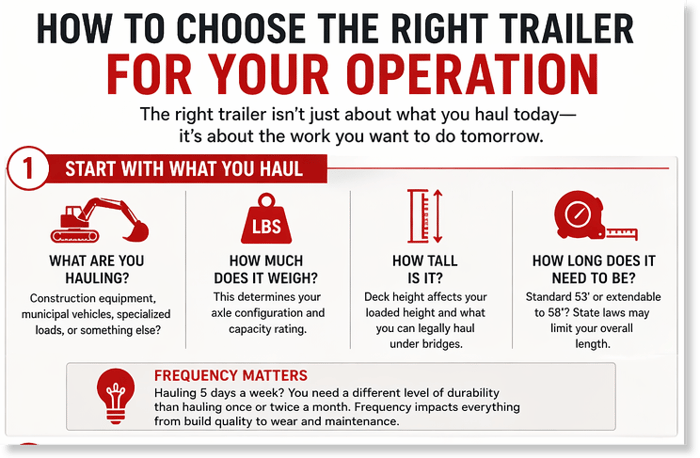
Three questions drive the majority of your trailer selection:
How much does it weigh? This determines axle count and capacity rating. Get it wrong and you either can't legally load the trailer or you're paying for more trailer than you need.
How tall is it? If your loaded height needs to come in at 14 feet to clear bridges, deck height becomes critical. The difference between an 18-inch deck and a 22-inch deck sounds small until bridge laws start eliminating loads every week.
How long does it need to be? Some loads fit a standard 53-foot trailer. Others need an extendable that can stretch to 58 feet. And some states won't let you run longer than 50 feet overall, so your operating territory factors in too.
Once you've answered those questions, the trailer type usually becomes clear:
Lowboys and RGNs are the core of heavy equipment hauling. The detachable gooseneck lets you load directly from the front, and configurations range from 35-ton mini-decks with a 12-inch loaded deck height up to 110,000-lb units with three axles and heavy-duty outriggers.
Sliding axle trailers are built for low-clearance equipment, containers, and agricultural machinery, with a low approach angle and deck-mounted winch for straightforward loading.
Extendable trailers transform from 53 to 58 feet for varying load lengths and are increasingly common in data center and infrastructure work.
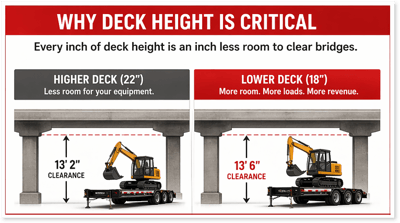 Deck height is the spec that catches the most buyers off guard and costs the most money over time. Bridge laws set hard limits on overall loaded height, and every inch of deck height is an inch less room for your equipment to clear.
A buyer who saves $10,000 by going with a higher deck often doesn't realize what they've given up until the work starts coming in. Loads they'd otherwise be eligible for get eliminated week after week. That's not a one-time loss. That's revenue walking out the door on a regular basis, going to competitors who spec'd the lower deck. Over months and years, the money lost on jobs you couldn't take dwarfs whatever you saved at purchase.
The question most buyers skip is also the most important: where is your operation headed?
Components like flip axles are the clearest example. A flip axle adds capacity to your existing trailer without buying a new one. At purchase, spending $25,000 on something you don't need today feels hard to justify. But when the work catches up three months later and you call your dealer hoping they still have one in stock, the picture changes fast. Manufacturers may have raised prices. The component might need to be built. And every week you're waiting is a week of work you can't take. Adding it at purchase is almost always cheaper, faster, and simpler.
If you're transitioning from step decks and flatbeds into heavy haul, or taking on equipment types you haven't hauled before, that's exactly when the right dealer conversation matters most. Most buyers call in knowing what they need to haul but not which trailer fits - and that's exactly the kind of question a knowledgeable dealer is built to answer.
A good dealer isn't just selling you a trailer. They're helping you match your investment to your operation so the trailer works as hard as you do.
The cheapest trailer that technically handles the load is rarely the smartest purchase. The right trailer is the one that keeps you eligible for the widest range of work over the longest period of time. For a complete walkthrough of specs, pricing, and how to evaluate manufacturers and dealers, our full buyer's guide, Before You Spend $100K+ on a Trailer - a practical buyer's guide for anyone in heavy-duty and equipment hauling, covers it all. Check it out!
%20-%202026-08-24T125429.867.png) HD Trailers Team : Jun 23, 2026
HD Trailers Team : Jun 23, 2026
Avoid costly mistakes when buying your first trailer. Learn key insights on pricing, critical components, and making informed decisions for your...
 HD Trailers Team : May 11, 2026
Compare heavy haul trailer pricing, from steel and deck height to axles, warranties, payload, and long-term cost.
![[New Guide] Your Trailer Isn't Equipment. It's Your Business Plan on Wheels.](https://blog.hdtrailers.com/hubfs/5%20trailer%20buying%20mistakes-1.png) HD Trailers Team : Jun 09, 2026
HD Trailers Team : Jun 09, 2026
[NEW GUIDE] Spec the right heavy-duty trailer before you buy - avoid costly mistakes, win more jobs, and invest with confidence.
%20-%202026-07-06T134213.259.png) HD Trailers Team : Sep 18, 2026
HD Trailers Team : Sep 18, 2026
Key essentials of heavy haul trailers, their unique features, and how to choose the right one for transporting oversized equipment efficiently.