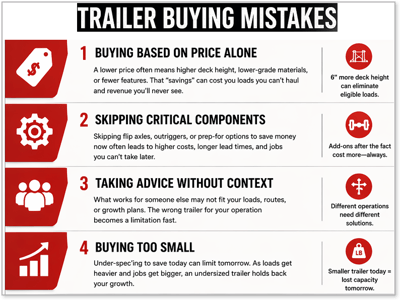
Here's the thing about trailer buying mistakes: almost none of them are surprising after the fact. Talk to any experienced hauler and they'll tell you exactly where they went wrong and exactly when they realized it. The patterns are predictable. A buyer tries to save money in the wrong place. A component gets skipped because it didn't seem necessary yet. Someone else's advice gets treated as gospel without asking whether it actually applies to a current situation.
The good news is that predictable also means preventable - if you know what to watch for before you sign.
Buying Based on Price Alone
This is the most common mistake in the industry. A buyer looks at two trailers with similar tonnage ratings and goes with the one that's $10,000 cheaper. Reasonable instinct. But that price gap almost always reflects a real difference in capability, and the most frequent place it shows up is deck height.
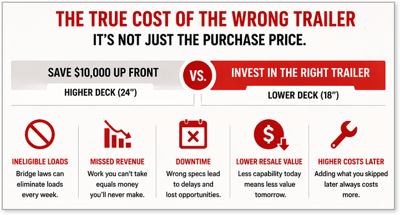
A 24-inch deck costs less than an 18-inch deck because it's simpler and lighter to build. But in markets where bridge laws are enforced - and they are enforced - those extra six inches can eliminate a significant percentage of the loads you'd otherwise be eligible for. That's not a one-time loss. That's work you're turning down every single week because your trailer can't clear the height requirement. The $10,000 you saved at purchase gets dwarfed by the revenue that never comes in.
We dig into this tradeoff in detail in our full buyer's guide, Before You Spend $100K+ on a Trailer, including a side-by-side comparison of real trailer models across deck height, capacity, and axle configurations. But the principle is simple: if you're comparing prices without comparing what each dollar buys you in access to work, you're not actually comparing.
Skipping Critical Components
The second most expensive pattern is buyers passing on components at purchase time because they don't need them yet. The most common ones:
-
Flip axles. A flip axle lets you scale your trailer's capacity without buying a whole new unit. At purchase, it feels like a $25,000 add-on for work you haven't landed. Three months later, when the work shows up and your dealer may or may not have one in stock, you're looking at higher prices, longer wait times, and jobs you can't take in the meantime.
-
Outriggers. Buyers coming from one trailer type often assume outriggers come standard on every configuration. On many mini-deck trailers, they don't - roughly eight out of ten ship without them. If your loads require outrigger support and you didn't spec them, you're dealing with that problem after delivery instead of before.
-
Prep-for options and expandability features. Most manufacturers offer prep packages at purchase - things like prep for a hydraulic flip axle, prep for a power booster, or air and electrical connections for future components. These are a fraction of the cost of adding them after the fact, and they keep the door open for scaling your trailer's capability down the road without a major retrofit.
The common thread is assuming that what you see on the lot is everything you need. Spec sheets have a standard equipment list and an options list for a reason. Knowing the difference before you buy saves you from learning it the hard way after.
Taking Advice Without Context
"My buddy runs this trailer and loves it" is a phrase that leads to more mismatched purchases than almost anything else. It's not that the advice is bad. It's that your buddy's operation isn't your operation. His loads are different. His routes are different. His growth plans are different. The trailer that's perfect for his business might put you in a position where you're turning down work within the first year.
This is especially common with buyers who are new to heavy haul and leaning on people they trust to shortcut the learning curve. The shortcut works fine when the operations are similar. When they're not, it's an expensive way to find out.
Buying Too Small
The instinct to not overspend is understandable. But first-time buyers almost always spec their trailer for the work sitting in front of them right now, and operations grow faster than most people plan for. The loads get heavier. The jobs get bigger. A trailer that handles today's work perfectly can become a limitation within a year.
Here's the math that most buyers don't run: saving $30,000 by going with a smaller trailer sounds like a smart financial decision. But if the right trailer would have opened up work worth even $1,000 more per month, that savings is gone within a few years - and you're still stuck with a trailer you've outgrown. Replacing it or watching those jobs go to competitors who can handle them is always the more expensive outcome.
Better Decisions Come From Better Information
Every one of these mistakes happens before the purchase, not after. By the time the trailer is on the lot and the loads are rolling, the decision has already been made. The buyers who get it right are the ones who had the full picture before they committed.
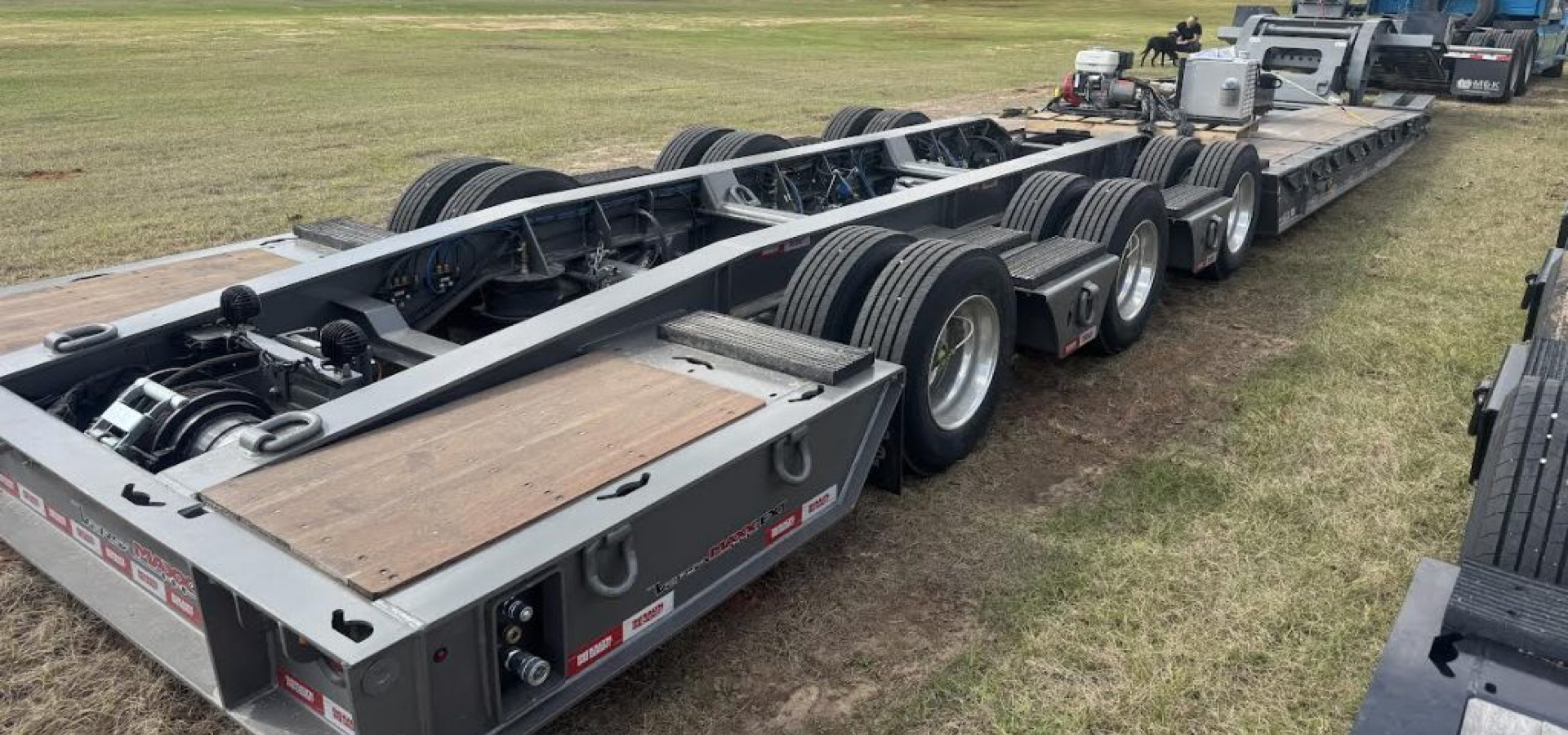
That's exactly what our buyer's guide, Before You Spend $100K+ on a Trailer - a practical buyer's guide for anyone in heavy-duty and equipment hauling, is built for. It covers everything from matching specs to your operation to understanding what drives pricing across manufacturers:
-
How to match trailer type and configuration to your specific equipment and industry
-
The specs that actually determine which jobs you can take
-
What drives price differences across manufacturers and what you're really paying for
-
How to evaluate warranty, dealer support, and inventory before you commit
Check out the guide before your next trailer purchase!