 HD Trailers Team
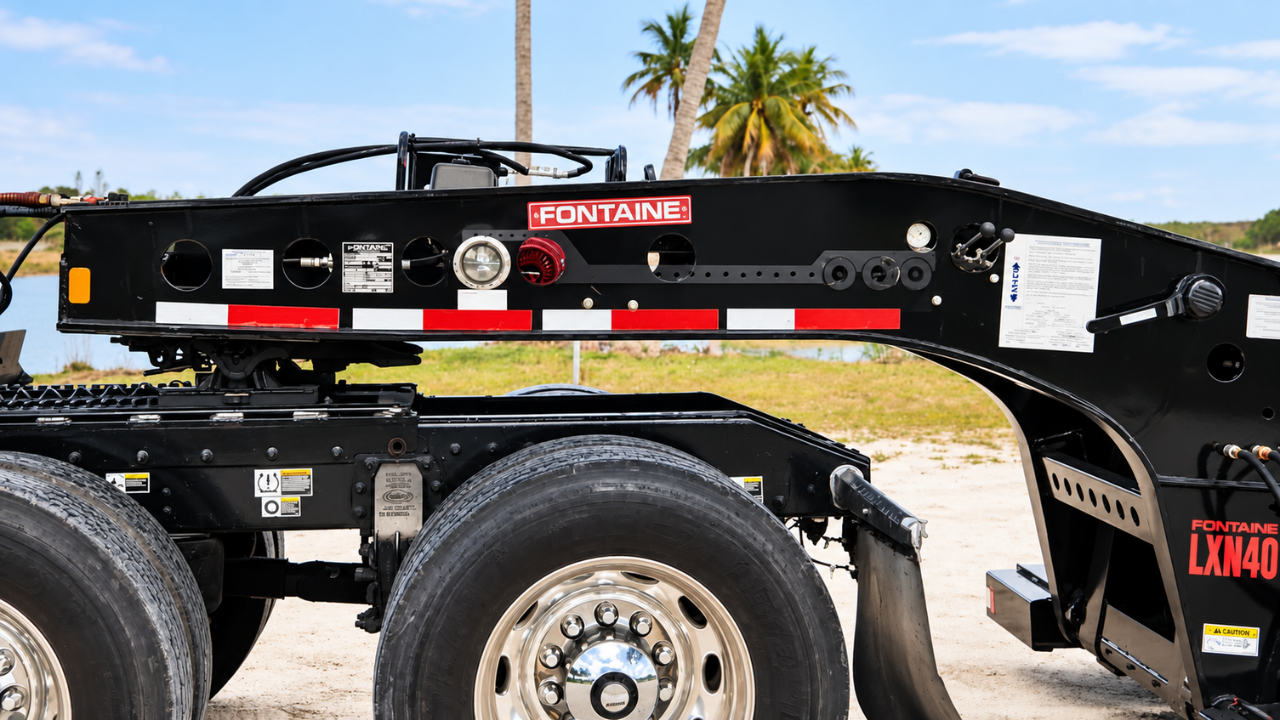
When you’re hauling tall equipment, four inches of trailer deck height can be the difference between running at legal height and needing an oversize permit.
Consider a machine that measures 12 feet tall in transport position. On an 18-inch loaded deck, the basic combined height is 13 feet 6 inches. Put that same machine on a 22-inch deck and the combination reaches 13 feet 10 inches.
That difference matters because 13 feet 6 inches is the maximum legal vehicle height in 29 states and Washington, D.C. Other states allow heights ranging from 14 to 15 feet, and requirements vary by jurisdiction. Once a combination exceeds the applicable state limit, permitting and route restrictions come into play.
For heavy-haul operators moving excavators, dozers, cranes, transformers, buses, tall vehicles, and other specialized loads, loaded deck height is more than another line on the spec sheet. It directly affects what you can haul and where you can haul it.
What Is Loaded Deck Height on a Lowboy Trailer?
Loaded deck height is the distance from the road surface to the top of the trailer’s main deck when the trailer is loaded and operating at its specified ride height.
Lowboy deck heights vary substantially by design. Depending on the trailer, configurations can range from roughly 12 inches into the 24-inch-plus range, with many heavy-haul lowboys falling somewhere between those points.
A few inches can have a major effect on total loaded height.
Take the same 12-foot-tall machine:
-
12-inch loaded deck: approximately 13'0" overall height
-
15-inch loaded deck: approximately 13'3" overall height
-
18-inch loaded deck: approximately 13'6" overall height
-
22-inch loaded deck: approximately 13'10" overall height
-
24-inch loaded deck: approximately 14'0" overall height
Those numbers are simplified examples, the actual transport height should always be measured on the loaded combination, but they show why deck height matters.
At 18 inches, the example reaches the common 13'6" legal-height threshold. Every inch of additional deck height after that can affect permitting and routing in states with a 13'6" limit.
That makes deck height a practical operating specification, not just a design preference.
Why Are Some Lowboy Decks Lower Than Others?
Deck height is the result of several parts of the trailer working together. Tire size, main-beam construction, suspension, capacity, and neck design can all affect how close the main deck sits to the road.
Tire and wheel size
Low-profile tires are one of the clearest ways to reduce deck height.
Heavy-haul designs using 17.5-inch wheels can sit lower than comparable configurations using 22.5-inch wheels. XL Specialized, for example, specifies 17.5-inch wheels on certain configurations and notes that an available 255/70R22.5 tire option increases deck height by 4.5 inches.
That is a significant change when you're already working close to a legal-height threshold.
Capacity and main-beam depth
Capacity creates another design tradeoff.
Higher-capacity trailers need enough structural strength to carry the rated load. Depending on the trailer's engineering and materials, that can require deeper or heavier main beams. Increasing structural depth can work against the goal of keeping the deck extremely low.
Manufacturers use high-strength steels and different beam designs to balance strength, trailer weight, ground clearance, and loaded deck height. The result is why two lowboys with different capacities, or even two trailers in the same nominal capacity class, may have noticeably different deck heights.
Don't assume the lowest deck will also provide the capacity and concentrated-load rating your operation requires. Compare the complete specification.
Suspension and adjustable ride height
Loaded deck height also isn't necessarily fixed at one position.
Some hydraulic and air-ride lowboys provide adjustable ride height. XL Specialized's Low-Profile HDG, for example, uses five-position variable ride height at the front along with rear ride-height adjustment.
That capability gives operators more flexibility than a simple "low deck versus ground clearance" comparison suggests. Depending on the trailer design and operating conditions, ride height can be adjusted to change clearance or deck position.
The manufacturer's operating limits and procedures still control how and when those adjustments should be used, but an adjustable setup can be valuable for fleets that encounter varying terrain and clearance requirements.
Deck Height Can Change Your Routing Options
Once a load exceeds the applicable legal-height limit, route planning becomes more complicated.
Permitted loads may need routes that account for bridge heights, overhead structures, utilities, tunnels, and other vertical restrictions. A route that works at one loaded height may not work after adding several inches.
That's why operators hauling tall equipment should work backward from the load.
If a machine measures 12 feet 4 inches in transport position, an 18-inch deck puts the basic combination at approximately 13 feet 10 inches. A 15-inch deck brings it down to approximately 13 feet 7 inches. A 12-inch deck gets it to approximately 13 feet 4 inches.
For an operation regularly working in states with a 13'6" legal-height limit, those differences can change the equation.
The important question isn't simply, "What's the lowest deck available?"
It's "What deck height gives our loads the clearance we need without compromising the capacity, ground clearance, and configuration required for the job?"
Lower Deck Height Comes With a Ground-Clearance Tradeoff
Getting the deck closer to the pavement naturally reduces the space available underneath it.
Real-world heavy-haul designs demonstrate the tradeoff.
XL Specialized has produced low-profile hydraulic detachable gooseneck configurations with a 15-inch loaded deck height and 4.5 inches of ground clearance. Its XL 110 Low-Profile HDG has also been offered with an 18-inch loaded deck height and 6 inches of ground clearance.
Kalyn Siebert's VersaMAXX design provides another example at the other end of the range: a 22-inch deck height with 6 inches of ground clearance, designed in part around transporting tall vehicles while maintaining a low loading approach.
The right combination depends on the work.
A very low deck may be valuable when overhead clearance is the primary constraint, but reduced ground clearance deserves attention around railroad crossings, uneven jobsites, steep transitions, and other changes in road surface.
Construction and heavy-haul fleets that regularly enter rough jobsites may make a different tradeoff than an operator primarily transporting tall equipment over paved routes.
Adjustable ride-height systems can add flexibility, but they don't eliminate the need to evaluate clearance for the actual operating environment.
Deck Height Also Affects Loading Geometry
Deck height matters before the trailer ever moves.
A lower main deck can reduce the vertical distance equipment has to travel during loading. Combined with the trailer's neck, ramps, transition geometry, and approach design, that can produce a shallower loading angle.
That can be particularly useful for equipment with limited ground clearance or long wheelbases.
The neck configuration matters here. With a Hydraulic Detachable Gooseneck (HDG/RGN) or Mechanical Detachable Gooseneck (MRG/MFG), equipment can be loaded from the front after the neck is detached. The height of the deck and the design of the front approach affect how the machine transitions onto the trailer.
For equipment such as pavers, buses, and other low-clearance machinery, approach angle may be just as important as loaded deck height.
A trailer can have an excellent transport height and still be the wrong configuration if the equipment can't be loaded efficiently.
Don't Shop for a Lowboy on Deck Height Alone
Loaded deck height matters, but it belongs in a larger specification package.
Before choosing a lowboy, compare:
-
Capacity and concentrated-load rating: Make sure the trailer is engineered for both the total payload and how that weight will be positioned on the main deck.
-
Main deck or well length: Verify that the equipment fits in the usable deck area and can be positioned correctly for weight distribution.
-
Ground clearance: Consider railroad crossings, jobsites, transitions, and the routes the trailer regularly encounters.
-
Deck width: Heavy-haul configurations commonly use deck widths from 96 to 120 inches depending on the application.
-
Neck configuration: Hydraulic Detachable Gooseneck (HDG/RGN), Mechanical Detachable Gooseneck (MRG/MFG), fixed-neck, and other designs change loading and operating characteristics.
-
Axle configuration and spacing: Tandem, triaxle, quad, 3+1, flip axle, jeep dolly, and other configurations affect weight distribution and permitted operation.
-
Suspension and ride-height adjustment: Determine whether the trailer offers the flexibility your routes and operating conditions require.
-
Fifth-wheel and neck geometry: Tractor fifth-wheel height affects how the trailer sits when coupled. An incompatible tractor/trailer setup can change deck attitude, ground clearance, and neck clearance from the intended operating geometry.
The best lowboy isn't necessarily the trailer with the lowest deck or highest capacity. It's the configuration that works as a complete system with your tractor, loads, routes, and operating conditions.
Think Beyond the Load You're Hauling Today
A lowboy is a long-term equipment investment, so consider where your freight mix is headed.
If you're already close to your common height limits, taking on taller equipment may expose the limitations of the trailer you have now.
The answer may be a lower-profile lowboy. For other operations, an Extendable, Mini Deck, different neck design, or additional axle configuration may provide more useful flexibility.
The same applies to fleets moving a mix of equipment. A trailer optimized around one excavator isn't necessarily the right choice if the next contract adds taller machinery, longer loads, or substantially different axle-weight requirements.
Build the specification around the work you expect the trailer to perform—not only the load sitting in the yard today.
Find the Right Lowboy for Your Operation
A few inches of loaded deck height can determine whether a load sits under a common legal-height threshold or moves into permitted territory.
But those inches don't exist in isolation.
Lowering the deck can affect ground clearance. Increasing capacity can change structural requirements. Tire size can change deck height. Suspension and hydraulic systems can provide ride-height flexibility. Neck and approach geometry can determine whether the equipment can be loaded efficiently in the first place.
That's why buying the right lowboy means comparing the complete configuration against the loads you actually move.
HD Trailers works with commercial heavy-haul operators across the country to source new and used equipment across multiple capacities, deck heights, neck configurations, and axle setups.
Browse current heavy-haul trailer inventory, or call 888-380-2509 to discuss your equipment dimensions, required capacity, deck height, ground clearance, and preferred configuration.
When a few inches can change the route, they're worth getting right before you buy.