 HD Trailers Team
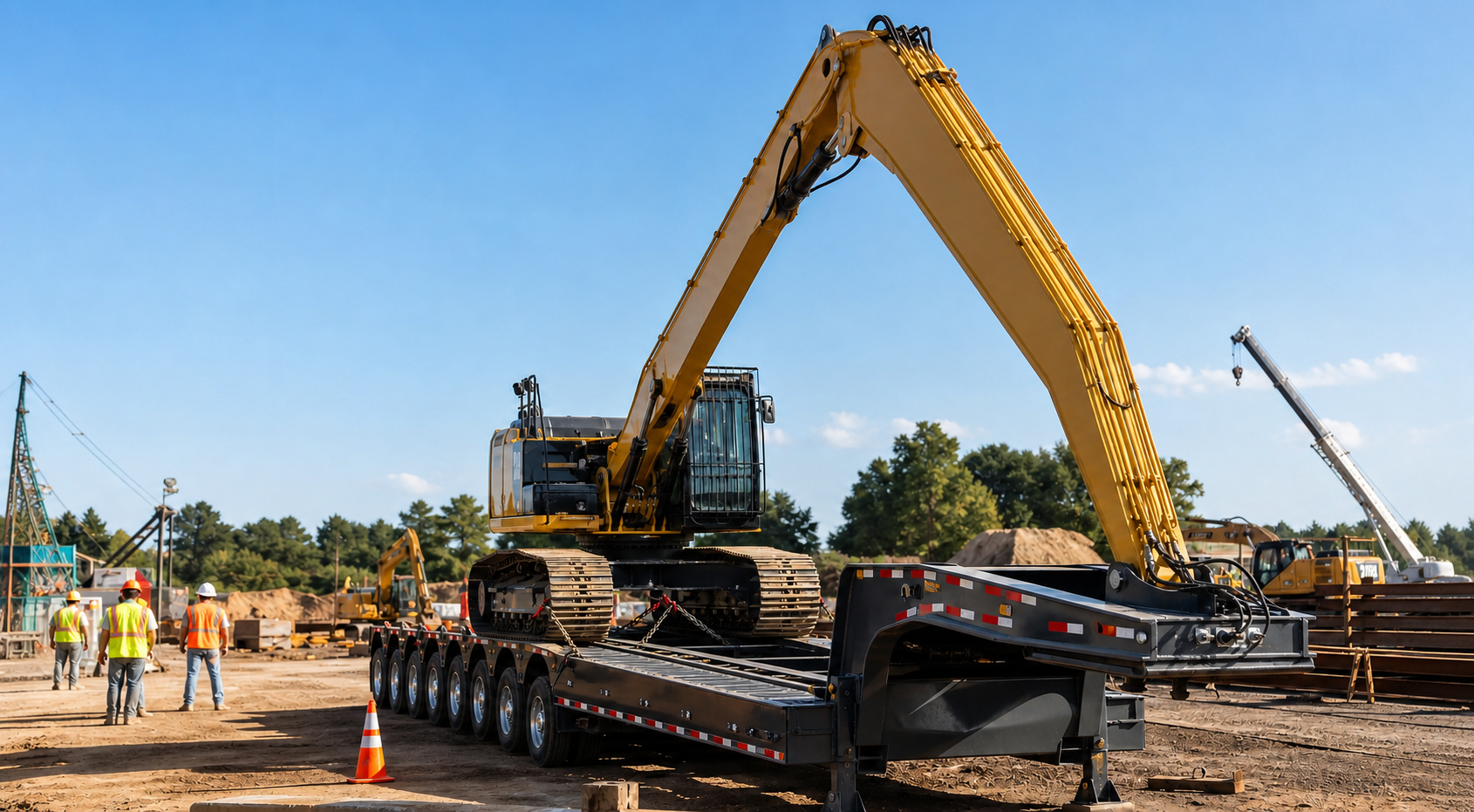
Heavy haul trailers can be built to carry loads ranging from approximately 50,000 pounds to more than 200,000 pounds, depending on the trailer’s rated capacity, design, axle configuration, and application.
But rated capacity only answers part of the question.
A trailer may be rated at 50 Ton, 75 Ton, or even 100+ Ton, but that does not automatically tell an operator how much weight the complete combination can legally carry over a particular road or bridge. Axle weights, axle spacing, tractor configuration, trailer weight, load placement, permits, and route restrictions can all affect the answer.
Heavy haul is also a broad category. It includes detachable goosenecks, mini decks, lowboys, extendables, multi-axle configurations, and other specialized equipment. Because these trailers solve different transportation problems, there is no single heavy-haul weight limit.
So when someone asks: “How much weight can a heavy haul trailer carry?”
There are really two questions to answer: What is the trailer engineered to carry, and what can the complete combination legally and safely transport for a particular move?
Understanding that difference is the starting point for choosing the right heavy-haul trailer.
Heavy Haul Trailer Capacity Explained
Heavy haul trailer capacity is commonly expressed in tons, with one U.S. ton equal to 2,000 pounds.
That makes the basic conversion straightforward, but the range of available heavy-haul equipment is substantial.
At the lower end of the heavy-haul range, a 25 Ton trailer represents 50,000 pounds of rated capacity, while a 35 Ton trailer represents 70,000 pounds.
Moving up in capacity, a 50 Ton trailer corresponds to 100,000 pounds, and a 60 Ton trailer corresponds to 120,000 pounds.
For more demanding heavy-haul applications, a 75 Ton trailer represents 150,000 pounds, an 85 Ton trailer represents 170,000 pounds, and a 100 Ton trailer represents 200,000 pounds.
Specialized configurations can extend beyond 100 Ton for loads exceeding 200,000 pounds.
HD Trailers works across this spectrum, with heavy-haul equipment ranging from 25 Ton through 100+ Ton depending on trailer type and configuration.
Those numbers make it easy to understand the general capacity class of a trailer, but they should not be interpreted as legal highway payload limits. A trailer's rated capacity, the way a load is distributed across its deck, and the amount of weight a complete combination can legally carry are separate considerations.
What Does a Trailer's Rated Capacity Actually Mean?
Suppose an operator is considering a 50 Ton detachable gooseneck trailer.
The basic conversion tells us that 50 tons equals 100,000 pounds. But that does not mean an operator can place any 100,000-pound machine anywhere on the deck and assume the trailer is properly loaded.
Trailer capacity can depend on how the weight is distributed and where it is concentrated on the deck.
That becomes especially important with heavy equipment.
Two excavators can have similar operating weights while placing that weight on a trailer differently because of their track length, center of gravity, attachments, and overall dimensions. A crane, transformer, or other concentrated load can introduce another set of considerations.
Manufacturers may specify rated capacity based on particular load concentrations or deck positions. Operators therefore need to review the specifications for the individual trailer rather than relying exclusively on its advertised tonnage.
The trailer should be treated as an engineered system, not simply a platform with a tonnage number attached to it.
Trailer Capacity and Legal Highway Weight Are Not the Same Thing
This is one of the most important distinctions in heavy haul.
Trailer capacity describes what the equipment is engineered to carry. Highway weight regulations govern what the complete vehicle combination can legally operate with on a particular road.
Under federal Interstate standards, normal limits generally include an 80,000-pound gross vehicle weight limit, 20,000 pounds on a single axle, and 34,000 pounds on a tandem axle, subject to the Federal Bridge Formula and applicable exceptions.
The Bridge Formula is particularly relevant because it considers the relationship between weight, the number of axles, and the distance between those axles.
That raises an obvious question: if normal Interstate gross weight is generally limited to 80,000 pounds, how do carriers move a 100,000-pound excavator, large transformer, or another load that already exceeds that amount before accounting for the tractor and trailer?
Heavy-haul operations frequently involve nondivisible oversize or overweight loads moved under permits. Requirements vary by jurisdiction, route, axle configuration, and the characteristics of the load.
Operators looking for federal background can review the Federal Highway Administration's commercial vehicle size and weight guidance.
A trailer's engineered capacity does not override applicable weight limits or permit requirements.
Why Axle Configuration Matters in Heavy Haul
As loads get heavier, asking how many tons a trailer can carry becomes less useful without also asking how that weight will be distributed.
That is where axle configuration becomes critical.
A tandem or triaxle setup may work for one application, while heavier freight may require a quad configuration, 3+1 setup, flip axle, jeep dolly, spreader arrangement, or a more specialized multi-axle combination.
The objective is not simply to put more tires underneath the trailer.
Axle count and spacing influence how weight is distributed across the complete combination. As the weight of the load increases, that distribution can become one of the primary factors determining how the trailer and route need to be configured.
This is why specialized multi-axle heavy-haul trailers should not simply be viewed as trailers with additional wheels. Their axle arrangements are part of how the equipment is configured for heavier work.
What Does a Flip Axle Do?
A flip axle provides an additional axle position behind the trailer.
For loads that require it, the additional axle can help distribute weight across another axle position. When the extra axle is not needed, compatible configurations may allow it to be flipped up.
That flexibility can be useful for commercial operators handling different types of heavy-haul work.
One move might work with the trailer's primary axle group, while a heavier load could require a different configuration. The ability to configure the trailer for the job can therefore be valuable for fleets that handle a broad range of equipment.
However, adding a flip axle does not automatically make an overweight load legal. Actual axle weights, spacing, trailer ratings, load placement, route requirements, and permits still have to be evaluated.
When Does a Jeep Dolly Make Sense?
As loads become heavier, distributing weight only behind the trailer may not be enough.
A jeep dolly adds axle positions between the tractor and main trailer, helping spread the load across additional axles and a longer overall combination.
This type of configuration is associated with more specialized heavy-haul work where a conventional tractor-and-trailer axle arrangement may not provide the distribution needed for the planned load.
At this level, choosing equipment becomes considerably more involved than finding a trailer with a sufficiently high tonnage rating.
The tractor, jeep dolly, trailer, rear axle groups, spreader components, load position, and route all become parts of the same system.
For operators pursuing heavier work, that configurability can matter just as much as the rated capacity of the main trailer.
How Trailer Type Affects Weight Capacity
Capacity also has to be considered alongside trailer design.
A detachable gooseneck (HDG/RGN) combines heavy-haul capacity with a low main deck and front-loading capability. That makes it a common configuration for excavators, dozers, cranes, and other construction machinery.
A mini deck puts greater emphasis on achieving a low loaded deck height. When a machine is both heavy and tall, keeping it lower can be just as important as having enough capacity to support its weight.
An extendable trailer solves another problem by providing additional deck length. Depending on its configuration, an extendable can be useful for long machinery, aerospace loads, wind-energy components, and other oversize freight.
For higher-capacity work, a multi-axle trailer can provide the additional configuration options needed to distribute heavier loads across more axle positions.
Manufacturers such as Alpha HD, Kalyn Siebert, XL Specialized, and Fontaine offer specialized heavy-haul equipment across different capacities and configurations. The correct comparison is not simply one brand or tonnage class against another. It is the actual trailer specification against the load an operator needs to move.
How Much Weight Can a 35 Ton Trailer Carry?
A 35 Ton trailer has a nominal rated capacity of 70,000 pounds. That puts it firmly within commercial heavy-haul applications, but whether a particular 70,000-pound machine belongs on a particular 35 Ton trailer requires more analysis.
Consider an excavator approaching the trailer's rated capacity.
Its operating weight is only the beginning. Track length and width determine how the machine contacts the deck. Attachments can alter both weight and center of gravity. Main-deck length determines how the machine can be positioned, while loaded deck height affects the overall height of the combination.
Two 35 Ton trailers can therefore perform differently with the same machine.
One may provide a lower loaded deck height. Another may have a longer well or a different axle configuration. A mini deck may solve a height problem that a conventional detachable gooseneck does not.
The 35 Ton rating establishes a capacity class. It does not eliminate the need to compare specifications.
How Much Weight Can a 50 Ton Trailer Carry?
A 50 Ton trailer corresponds to 100,000 pounds of nominal rated capacity.
At this level, operators may be moving larger excavators, dozers, construction equipment, industrial machinery, or other substantial loads.
The distinction between trailer capacity and legal payload becomes particularly important here.
The tractor has weight. The trailer has weight. Fuel and equipment add weight. A jeep dolly, flip axle, spreader, or other components add additional weight to the complete combination.
Then there is the load itself.
Instead of simply asking, “Can this trailer carry 100,000 pounds?”, a heavy-haul operator needs to ask:
“Can this trailer and complete combination safely and legally transport this particular 100,000-pound load over the planned route?”
Those are very different questions.
How Much Weight Can 75 Ton and 100+ Ton Trailers Carry?
A 75 Ton trailer represents 150,000 pounds of nominal capacity, while a 100 Ton trailer represents 200,000 pounds.
Equipment exceeding 100 Ton can move beyond 200,000 pounds of rated capacity.
At these levels, operators are entering increasingly specialized heavy-haul territory.
Applications may include large transformers, cranes, major construction machinery, energy infrastructure, and other oversize or overweight nondivisible loads.
The trailer itself is only one component of these configurations. Jeep dollies, flip axles, spreaders, additional axle groups, and careful load positioning may all become relevant depending on the equipment and move.
Route planning and permitting also become increasingly important.
A 100+ Ton trailer may have the engineered capacity required for a load, but that does not mean every road or bridge along a proposed route can accommodate the complete combination.
That is why higher-capacity heavy haul requires the trailer, tractor, axle configuration, load, and route to be evaluated together.
Don't Forget the Trailer's Own Weight
When comparing heavy-haul capacity, another number deserves attention: the trailer's own weight.
Payload and gross combination weight are not the same thing.
The tractor, trailer, fuel, driver, accessories, jeep dolly, flip axle, spreader components, and other equipment all contribute to the total weight of the combination before the freight itself is considered.
This becomes especially relevant as trailer capacity increases.
Higher-capacity trailers often require additional structure, axles, and components. Those features provide the strength and configuration required for heavier work, but they also add weight.
That is one reason buying substantially more capacity than the operation requires is not automatically an advantage.
The goal is to have enough trailer for the work while understanding how the entire combination will operate.
Deck Height Can Matter as Much as Weight
A trailer can have enough capacity for a machine and still be the wrong trailer for the job.
Suppose an excavator falls comfortably within a trailer's rated capacity, but the trailer's loaded deck height causes the machine to sit several inches higher than it would on another configuration.
Those inches may become significant when overall loaded height is already a concern.
That is why loaded deck height, ground clearance, main-deck or well length, deck width, fifth-wheel height, swing clearance, and axle configuration all belong in a capacity discussion.
Mini decks demonstrate this especially well. Their value is not necessarily that they carry more weight than another trailer in the same capacity class. Their lower deck can help an operator carry the required weight at a lower overall loaded height.
Sometimes the problem is not carrying more.
It is carrying the same load lower and in the right configuration.
More Capacity Isn't Automatically Better
It can be tempting to approach heavy-haul trailer selection by buying the highest capacity available.
That can make sense when an operation expects to move into heavier work and the additional capacity supports a clear business need. But a 75 Ton trailer is not automatically a better purchase than a 50 Ton configuration simply because its rated capacity is higher.
Higher-capacity equipment can bring different tare weights, axle configurations, dimensions, tractor requirements, maneuverability considerations, and operating characteristics.
If most of a fleet's work falls comfortably within a particular capacity class, moving substantially above it may introduce compromises without creating meaningful additional capability for the loads the company actually handles.
Capacity should therefore be matched to the operation rather than maximized for its own sake.
Choosing the Right Heavy Haul Trailer Capacity
The best place to start is with the actual equipment or freight you intend to move.
Know its weight and dimensions, but go further. Understand its center of gravity, how its weight will contact the deck, how much usable well length it requires, and what the complete loaded height is likely to be.
Then consider how the trailer fits into the rest of the combination.
Fifth-wheel height, tractor configuration, axle spacing, suspension, deck width, optional flip axles or jeep dollies, and the position of the load can all affect the final setup.
If the work involves oversize or overweight freight, route and permit requirements need to be considered as part of the equipment decision rather than after the trailer has already been selected.
This is why rated capacity should be treated as a starting point.
A 35 Ton trailer corresponds to 70,000 pounds.
A 50 Ton trailer corresponds to 100,000 pounds. A 75 Ton trailer corresponds to 150,000 pounds.
A 100 Ton trailer corresponds to 200,000 pounds.
Those numbers tell you where to begin looking.
The trailer's specifications and the requirements of the load determine where that search should end.
Need More Capacity for Your Next Load?
Moving from a 35 Ton trailer to a 50, 75, or 100+ Ton configuration involves more than increasing the number on the capacity rating. Axle configuration, deck dimensions, loaded height, tractor setup, and the type of freight you're pursuing all need to work together.
Browse HD Trailers' current heavy-haul inventory to compare available trailers across different capacity classes and configurations.
If you're trying to determine which setup fits the work you're planning to haul, call 888-380-2509 or email sales@HDtrailers.com to discuss your requirements with the HD Trailers team.
Trailer ratings, payload capability, axle capacities, and legal operating weights vary by equipment and configuration. Always verify manufacturer specifications and applicable federal, state, local, route, and permit requirements before transporting a load.